How NH Property Tax Rates Are Set, Part by Part
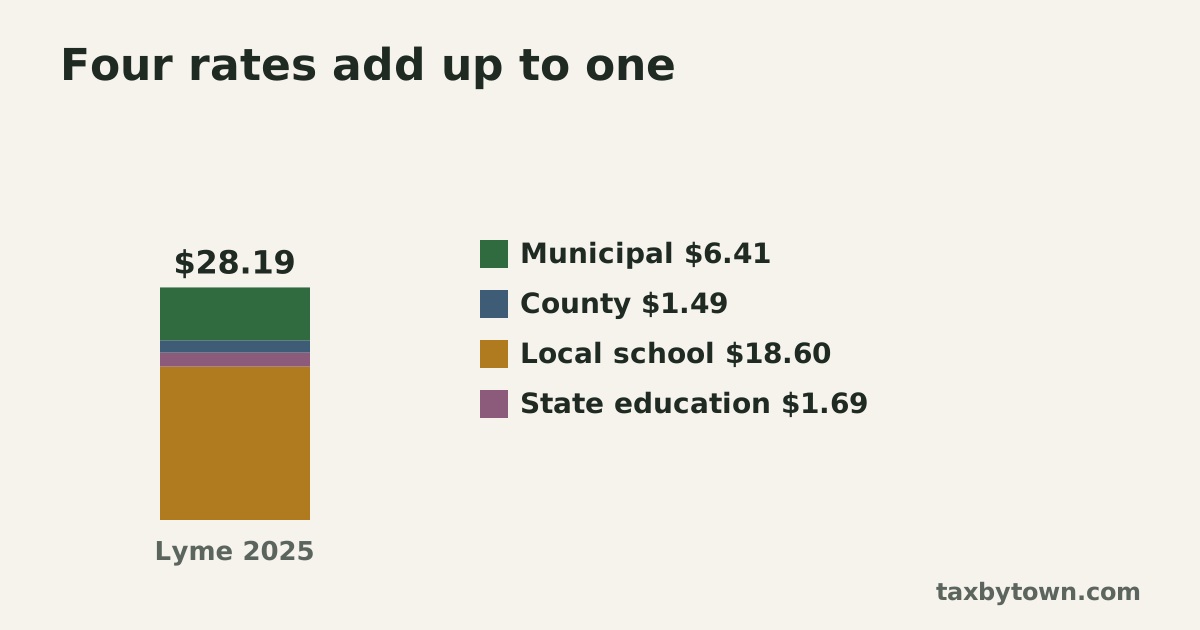
A New Hampshire property tax rate is not chosen; it is worked out. Every autumn the Department of Revenue Administration (DRA) takes what each town has to raise by property tax and divides it by the town's assessed valuation. The result, per $1,000 of value, is the rate printed on the bill. The median town's 2025 rate is $16.90.
The four parts
Each rate is four rates added together:
- Municipal: the town or city budget, after other revenue such as motor vehicle fees and state aid.
- County: the town's share of the county budget, apportioned under RSA 29:11.
- Local education: the school district's net cost after state aid and the state education tax.
- State education: the statewide education property tax, which the town collects but which stays with its schools.
Statewide medians for 2025: municipal $4.59, county $1.34, local education $9.75 and state education $1.13. Every town page shows its own four parts against those medians.
Worked example: Lyme, 2025
The DRA's 2025 rate calculation for Lyme, which the town posts, shows each step.
| Item | Figure |
|---|---|
| Valuation including utilities | $416,844,800 |
| Valuation without utilities | $412,824,200 |
| Net municipal tax effort | $2,671,658 |
| Net county apportionment | $622,457 |
| Municipal rate | 2671658 ÷ 416844800 × 1,000 = $6.41 |
| County rate | 622457 ÷ 416844800 × 1,000 = $1.49 |
| Total rate | $6.41 + $1.49 + $18.60 + $1.69 = $28.19 |
The state education rate is the exception: The statewide education tax is assessed on "all persons and property taxable pursuant to RSA 76:8, except property subject to tax under RSA 82 and RSA 83-F", so its rate applies to the valuation without utilities. Run backwards, Lyme's rates raise ($28.19 − $1.69) × $416,844,800 ÷ 1,000 plus $1.69 × $412,824,200 ÷ 1,000 = $11,744,060, which is the DRA's total tax effort to the dollar. Take away $35,500 of veterans' credits and you reach the $11,708,560 commitment, the tax Lyme actually bills.
Why two towns with the same budget have different rates
Because the denominator is the town's assessed valuation, a town that assesses at 70% of market value needs a higher rate than one assessing at 100% to raise the same money. That is why rates alone do not compare bills between towns; the guide to assessed and market value shows how the equalization ratio corrects for it. It is also why a revaluation lowers the rate without lowering the budget.
When rates are set
Rates for the 2025 tax year (which runs from April 1, 2025) were set between October 2025 and January 2026; each town page gives the date the DRA set its rate. Until then, the July bill is an estimate at half the prior year's tax, explained in how NH bills are paid.
Sources
- NH Department of Revenue Administration, 2025 Municipal Tax Rates (completed as of January 23, 2026): DRA, copy read.
- NH DRA, Lyme 2025 tax rate calculation (posted by the Town of Lyme), read 2026-10-20.
- RSA 76:3, Statewide Education Property Tax; RSA 29:11.
Questions
Who sets a New Hampshire town's tax rate?
The Department of Revenue Administration approves each town's rate every autumn from the town's appropriations, revenues and assessed valuation. 2025 rates were set between October 2025 and January 2026.
What are the four parts of the rate?
Municipal, county, local education and state education. Each is a tax effort divided by the town's valuation, per $1,000.
Does the state education rate apply to utility property?
No. The statewide education tax is assessed on "all persons and property taxable pursuant to RSA 76:8, except property subject to tax under RSA 82 and RSA 83-F", so its rate applies to the valuation without utilities.