Why Your Tax Bill Rose When the Rate Fell
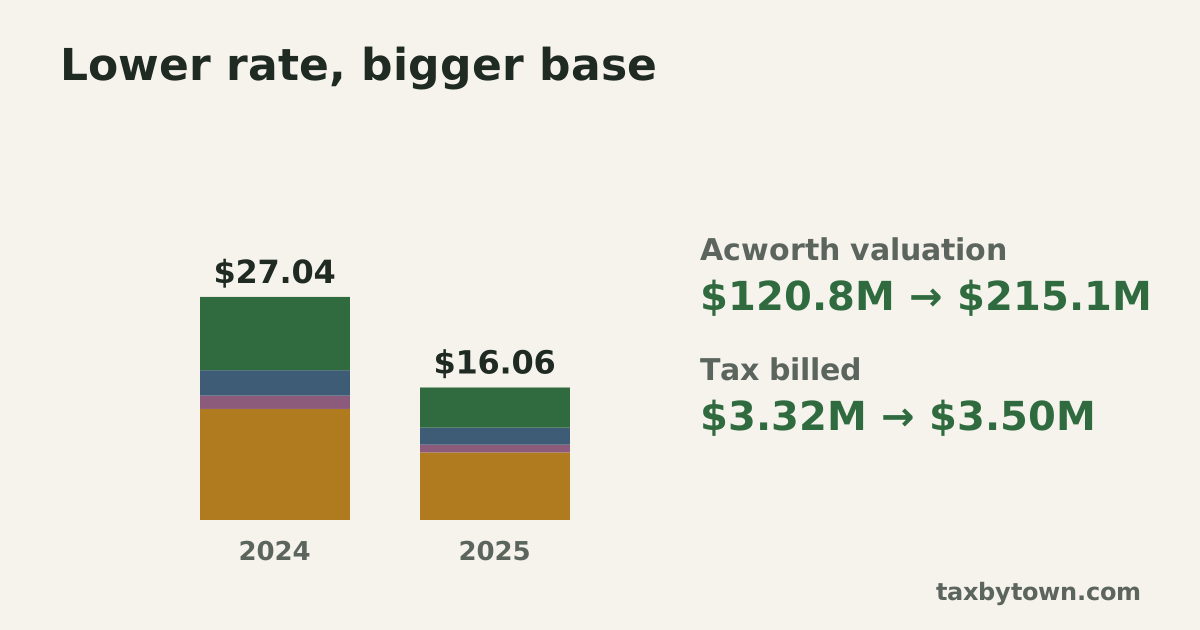
A falling rate is the most misread number on a New Hampshire tax bill. The rate is the town's tax effort divided by its assessed valuation, so when assessments go up in a revaluation, the rate comes down even if the town raises more money than before. Whether your own bill rises depends on how your assessment moved against the town's.
Acworth, 2024 to 2025
| 2024 | 2025 | |
|---|---|---|
| Total rate per $1,000 | $27.04 | $16.06 |
| Assessed valuation (without utilities) | $120,780,310 | $215,118,470 |
| Total commitment | $3,322,257 | $3,498,120 |
Acworth's valuation grew 78.1% and its rate fell 40.6%, yet the property tax it billed went up, from $3,322,257 to $3,498,120.
Take a house assessed at $200,000 in 2024, which paid $5,408.00. If the revaluation raised it by exactly the town's 78.1%, to $356,214, the 2025 bill is $5,720.80. A house whose assessment rose more than the average pays more than that; one that rose less pays less. The rate drop by itself tells you nothing about your bill.
Nottingham, same pattern
Nottingham's rate went from $20.46 to $13.20 while its valuation grew 74%, from $821,830,701 to $1,429,611,013. The town's own notice gives the same $13.20 rate. See the Nottingham page for each part of the rate.
How many towns this happened to
In 53 of New Hampshire's 234 municipalities the valuation without utilities grew 15% or more between 2024 and 2025 while the total rate fell: Acworth, Albany, Alstead, Brentwood, Bristol, Colebrook, Croydon, Deerfield, Deering, Dunbarton, Durham, Easton, Effingham, Ellsworth, Epping, Epsom, Fremont, Gorham, Goshen, Grafton, Hanover, Hart's Location, Hillsborough, Jaffrey, Lebanon, Lempster, Litchfield, Littleton, Lyman, Lyndeborough, Madbury, Madison, Marlow, Milan, New Durham, Newton, Northwood, Nottingham, Orange, Orford, Peterborough, Pittsfield, Plaistow, Rindge, Springfield, Sutton, Tuftonboro, Warner, Wilmot, Winchester, Windham, Wolfeboro, Woodstock. Towns must reappraise at full and true value at least every 5 years (RSA 75:8-a), so every town goes through this in turn.
What to compare instead
- Your assessment change against the town's valuation change (the town page shows the town's).
- Your bill in dollars, year against year, rather than the rate.
- After a revaluation, the new assessment against market value on April 1, using the town's equalization ratio; the assessed vs market value guide and the appeal page explain the official route if they disagree.
Sources
- NH Department of Revenue Administration, 2025 Municipal Tax Rates (completed as of January 23, 2026): DRA, copy read; NH Department of Revenue Administration, 2024 Municipal Tax Rates (completed as of June 9, 2025): copy read.
- Town of Nottingham, 2025 Tax Rate Set.
- RSA 75:8-a, Assessment.
Questions
Why did my town's rate drop so much?
Usually because assessments were updated and the tax base grew. Acworth's valuation went from $120,780,310 to $215,118,470 and its rate from $27.04 to $16.06.
How often must NH towns revalue?
At least every 5 years (RSA 75:8-a).